[ Graphic design ]
Business card design: the numbers behind type size, QR codes, bleed and size
A business card is read at about 40 cm. At that distance vision research puts comfortable text near 8 point for a typeface with a 0.52 x-height, above the 6 point floor some printers quote. There is no standard size, so use your region's and the printer's template. Print a short link as the QR code, not a full vCard, and confirm the bleed, because 2 mm and 3 mm are both in use.
By LAIN10 min read
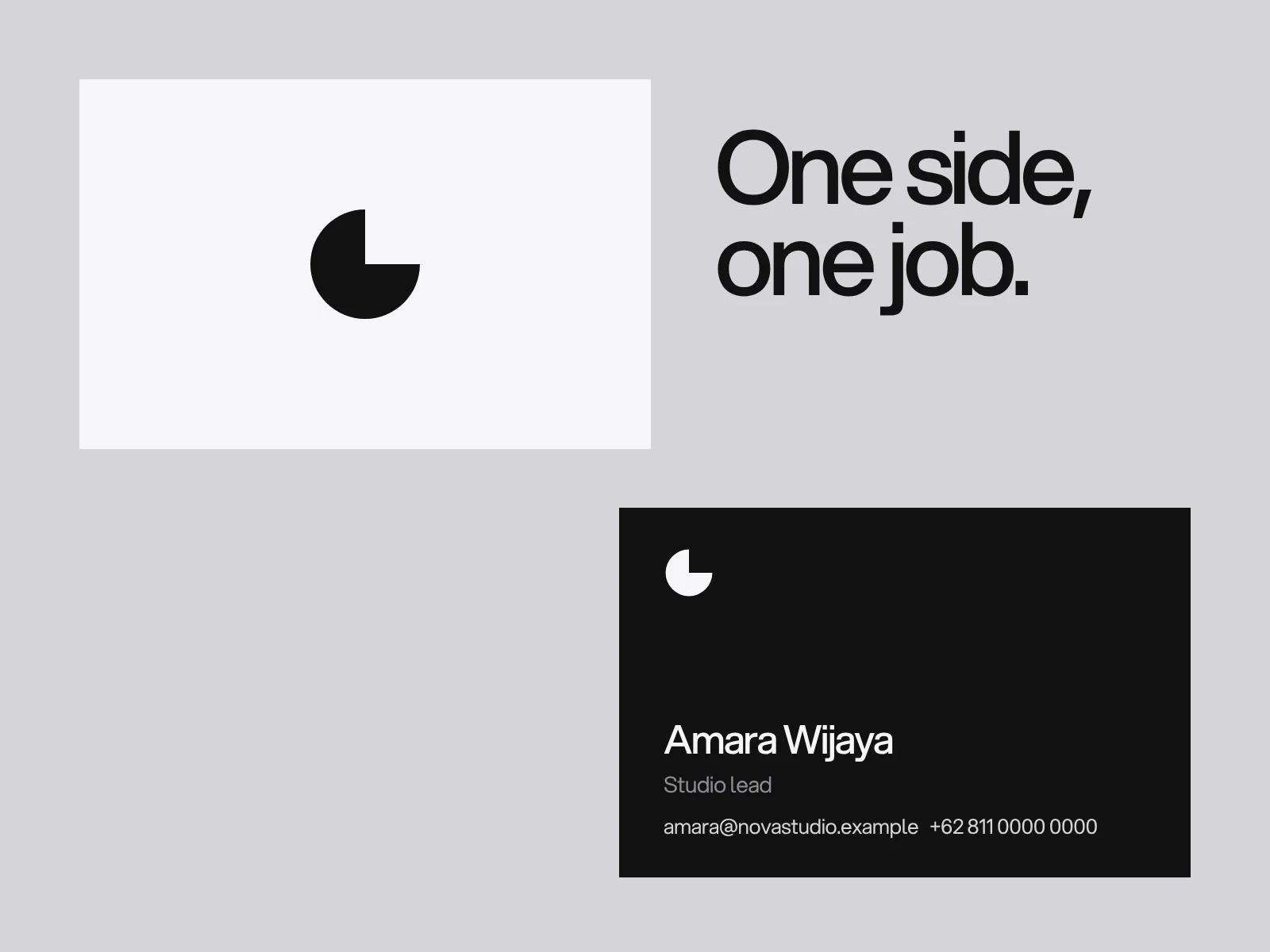
A business card is held at arm's length for a few seconds, then typed into a phone or scanned, then kept or lost. Design it for those two moments. Three decisions carry most of the weight, and each has a number behind it: the type size, the QR code and the trim. Most guides state them as habits. Here is where each one comes from, so you can check it against your own card.
There is no standard size
Wikipedia's entry is blunt: there is no standard for business card dimensions. Families of sizes exist by region:
| Where | Trim size |
|---|---|
| UK and much of continental Europe | 85 x 55 mm |
| Australia, Denmark, India, New Zealand, Norway, Sweden, Vietnam, Taiwan | 90 x 55 mm |
| China, Hong Kong, Malaysia, Singapore | 90 x 54 mm |
| Japan | 91 x 55 mm |
| United States and Canada | 88.9 x 50.8 mm (3.5 x 2 in) |
| Argentina, Brazil, Mexico, Russia and others | 90 x 50 mm |
Wikipedia also lists the credit-card format (ISO/IEC 7810 ID-1, 85.60 x 53.98 mm) and notes that sharing dimensions with other cards makes storage easier. Our comparison: the European 85 x 55 mm card is within about 1 mm of ID-1 in both directions, while the US card is 3.3 mm wider and 3.2 mm shorter, and its proportion (1.75) is far from Europe's (1.55). A layout for one will not transfer to the other without redrawing. For cards handed out in several regions, the 85 x 55 mm size is the nearest to what wallet slots are cut for. That is our judgement, not a rule.
Bleed is 2 mm or 3 mm, depending on the printer
The old rule of thumb says 3 mm. One printer's guide gives a European 85 x 55 mm card a bleed size of 89 x 59 mm, which is 2 mm per side, and a Japanese card 95 x 59 mm. It describes bleed generally as 0.125 inch or 2 to 3 mm, and asks for critical content at least 0.125 inch inside the trim. At 300 ppi, the European card is 1051 x 697 pixels with 2 mm bleed and 1075 x 720 with 3 mm. The guides disagree, so use the printer's template, not a generic one.
Set the type from the angle, not from habit
Printers give floors. One print shop's guide recommends 7 to 8 pt for phone and email with 6 pt as the minimum, and 9 to 11 pt for the name with 8 pt as the minimum, on a 90 x 55 mm card. Vision research asks a different question: at what size does reading run at full speed?
Legge and Bigelow's review of the vision science puts the critical print size at about 0.2 degrees of x-height. At 40 cm that is an x-height of 1.4 mm, which is 4 pt. Newspaper text averages 0.23 degrees and novels 0.24. Below the critical size reading slows. We turned that into font sizes by dividing the x-height by the typeface's x-height ratio. We measured the ratio in the faces used on this site: Aspekta 0.52, Inter 0.546.
| Reading distance | x-height ratio 0.45 | 0.52 | 0.55 |
|---|---|---|---|
| 35 cm | 7.7 pt | 6.7 pt | 6.3 pt |
| 40 cm | 8.8 pt | 7.6 pt | 7.2 pt |
| 50 cm | 11.0 pt | 9.5 pt | 9.0 pt |
So at 40 cm, 8 pt in a face with a 0.52 x-height is right at the threshold (0.21 degrees), and 6 pt in the same face is 0.16 degrees, below it. A printer's 6 pt floor is where the print survives, not where reading is comfortable. A face with a small x-height needs more: 0.45 needs 8.8 pt. Two cautions. Contact details are read in short pieces, not as running text, so the threshold is a conservative guide, and 40 cm is an assumption (it is the example distance in the paper). If your readers hold the card further away, size grows in direct proportion to distance.
The printer's adjustments still apply on top. The same shop adds 0.5 to 1 pt on uncoated stock and 1 to 1.5 pt for light type on a dark ground, asks for Regular or Medium weights below 9 pt and says to avoid condensed faces below 8 pt. Put together, 8 pt is the floor for contact details in a normal-width face on coated stock, and 9.5 to 10.5 pt for reversed type on uncoated.
Design for transcription
Ask what happens after the handshake. Someone reads a number and types it. So give one name, one role and one way to reach you, plus one place to learn more.
- Phone numbers in international form. ITU-T E.164 numbers have at most 15 digits, and the leading plus sign means "dial with the caller's international prefix". E.123 recommends the plus and spaces only for grouping. Write +44 20 7946 0123, not 020 7946 0123, or the number fails abroad.
- Email on its own line at a size you can read aloud without guessing. Letters that look alike at small sizes (0 and O, 1, l and I) are where typing errors start, so read the address aloud to a colleague from the printed proof.
- Names. In Japan executives often carry two cards, one with the name in Japanese order and one in Western order, and the card is offered face up and received with both hands, according to Wikipedia's entry on the meishi.
- Leave out fax numbers, generic info@ addresses and every social network you do not use for work.
QR codes: a link beats a vCard
A QR code encodes bytes, and more bytes mean more modules, the small black squares. A version 1 code is 21 modules wide and each version adds 4 per side. We computed three payloads with error correction level M:
| Payload | Bytes | Version | Modules per side | Module size on a 20 mm code |
|---|---|---|---|---|
| Short link | 22 | 2 | 25 | 0.80 mm |
| Contact text (MeCard) | 95 | 6 | 41 | 0.49 mm |
| Full vCard 3.0 | 179 | 9 | 53 | 0.38 mm |
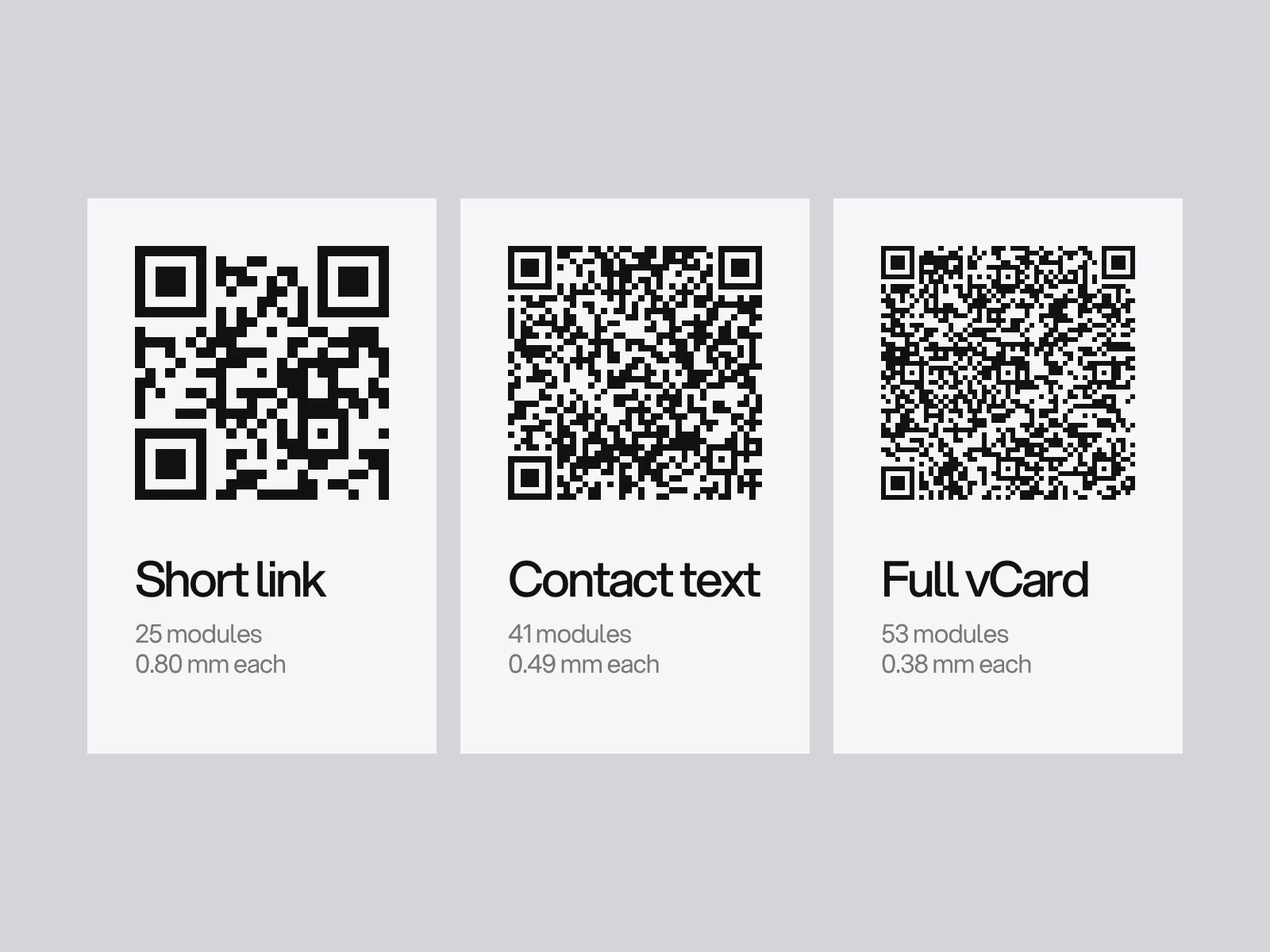
The full vCard has modules less than half the size of the link's. Ink spreads more on uncoated stock, which is the usual reason printers add size to small type there, and the same spread can fill in small gaps. Deloitte's QR guidance recommends at least 2 by 2 cm, four modules of white around the code and, for a code without a logo, the lowest error correction level to keep it small. A printed vCard also cannot be updated after printing, while a short link can point wherever you need. Encode a short link to a contact or booking page, and test the printed card with two phones.
Paper and finish
Print shops treat about 350 gsm as the standard for a solid card and 400 gsm as noticeably more substantial. Below 300 gsm one shop says it feels like a flyer. The shops we read give no thickness in millimetres, so ask for samples. Finish is a trade-off: uncoated is the easiest to write on, and gloss and soft-touch coatings resist ink and take no handwriting. Uncoated needs the larger type sizes above, so test small type on the actual stock.
Prepare the file
Pass or fail before it goes to print:
- Template and bleed: from the printer, for your region, with the bleed they specify.
- Safe area: text at least 0.125 inch (3.2 mm) inside the trim.
- Type: contact details at 8 pt or more, 10 pt if reversed on uncoated.
- Resolution: images at 300 ppi at final size.
- Black: small text at K100 only. White text on colour needs size and weight, since one printer says small knocked-out text cannot be registered correctly.
- QR code: at least 20 mm, short link, tested on the stock.
- Proof: read every digit of every number and email aloud.
Where this goes wrong
The type is 6 pt because the printer allows it. Cause: printer floors protect the print, not the reader. Detect: hold the proof at 40 cm for five seconds. Fix: size from the table.
The number does not work abroad. Cause: a national format without the country code. Fix: E.164 form with a plus sign.
The QR code will not scan on uncoated stock. Cause: a dense vCard with small modules and ink spread. Fix: a short link, a larger code and a test on the real paper.
The layout shifts when printed in another country. Cause: no standard size, and a template for the wrong region. Detect: compare proportions, 1.55 against 1.75. Fix: redraw at the printer's size.
Text is clipped at the edge. Cause: a cut that shifts and content outside the safe area. Fix: 3.2 mm inside the trim.
Put it into practice
Print one card at 100 percent at home, hold it at 40 cm and read the phone number aloud. The business cards in our identity work, such as black and mist green for Urbanova, the cards for a first meeting in Creagen Hayes and those set beside the wider identity in Ordin, are designed as part of a system. Graphic design at LAIN typically takes 2 to 4 weeks, and cards work best with the identity they belong to; our guide to brand identity vs logo explains why. For the print file in general, see the brochure checklist, and for hierarchy, typographic hierarchy. If you want cards that match a full brand, start a project.
Frequently asked questions
What is the standard business card size?
There is no standard. Common sizes are 85 x 55 mm in the UK and much of Europe, 88.9 x 50.8 mm (3.5 x 2 in) in the United States and Canada, 90 x 55 mm in Australia and several Asian countries, 90 x 54 mm in China, and 91 x 55 mm in Japan. Use the size common where you hand the cards out, and get the printer's template.
What font size should a business card use?
At 40 cm, vision research puts full-speed reading at about 0.2 degrees of x-height, which is 1.4 mm. In a typeface with a 0.52 x-height ratio that is about 7.6 pt, so use 8 pt or more for contact details. Some printers quote 6 pt as a minimum, but that is below the threshold. Add 0.5 to 1 pt on uncoated stock and 1 to 1.5 pt for light type on dark.
How much bleed does a business card need?
It depends on the printer: one guide gives 89 x 59 mm for a European 85 x 55 mm card, which is 2 mm per side, while the usual rule of thumb is 3 mm. Use the printer's template, and keep text at least 0.125 inch (3.2 mm) inside the trim.
Should I put a QR code on a business card?
Only if it opens something specific, and use a short link rather than a vCard. A 22 character link needs a 25 module code, which gives 0.80 mm modules on a 20 mm square, while a full vCard needs 53 modules at 0.38 mm. Smaller modules fill in on uncoated stock. Print it at least 20 mm wide with white space around it and test it.
How should I write my phone number on a business card?
In international format with a plus sign and country code, grouped with spaces, for example +44 20 7946 0123. ITU-T E.164 numbers have at most 15 digits, and the plus sign tells the reader to dial with their own international prefix. A national format without the country code fails for anyone abroad.
What paper weight is best for business cards?
About 350 gsm is treated as the standard for a solid card, with 400 gsm as a more substantial option and anything below 300 gsm described as feeling like a flyer. The shops we read do not quote thickness, so ask for samples. Uncoated stock takes handwriting, and coated finishes resist ink.
Sources and fact check
Facts in this article that come from outside LAIN were checked on 28 Oct 2026 against:
- Wikipedia: Business card (sizes by country, meishi etiquette)
- Wikipedia: ISO/IEC 7810 (ID-1 dimensions)
- Wikipedia: E.164 (ITU-T numbering plan, E.123 style)
- Legge and Bigelow (2011), Does print size matter for reading? Journal of Vision
- Paperlust: Business card font size
- Printkeg: Standard business card sizes guide
- Xcel: Business card paper weights and finishes
- Deloitte QR: What is the minimum size of a QR code?
- Denso Wave: QR code versions and sizes
- Tradeprint: why has my white text printed a different colour
Timelines, services and process described here are LAIN's own, as set out on our About and FAQ pages.
[ From our work ]

[ Keep reading ]