[ Social media ]
A social media style guide: rules someone else can fail
A social media style guide works when every rule can be checked by someone other than its author. Sort rules into taste, platform and legal, put a review date on the platform ones, because Instagram moved from 30 hashtags to five in late 2025, and write the legal ones, such as ad disclosure, as plain never-do lines on page one.
By LAIN10 min read
A social media style guide fails for one reason: nobody can tell whether a post has broken it. "Be friendly but professional" cannot fail, so it cannot guide. This article sorts the rules by who owns them, gives each kind a review date, and shows how to write every rule as a check that someone else can fail. It also covers the parts of a social guide that have an outside specification and have changed lately: Instagram's hashtag cap, ad disclosure, music licensing and alt text.
Three kinds of rule, three lifespans
Most guides list voice, hashtags and emoji side by side as if they were the same sort of rule. They are not. They differ in who can change them.
| Kind | Who owns it | Examples | Review | Source of truth |
|---|---|---|---|---|
| Taste | The brand | One crop, two backgrounds, logo bottom left, plain words | At a rebrand, or when the feed drifts | Your brand guidelines |
| Platform | The platform | Hashtag cap, caption cut-off, music library, alt text controls | Every quarter | The platform's help page, with the date you checked it |
| Legal | A regulator or the law | Ad disclosure, rights to reposted work | When the law or a campaign changes | The regulator's page, linked |
The platform row is where guides rot. Instagram said in December 2025 that it "will gradually update the number of hashtags that you can include in a caption for a reel or post to five", where 30 had been allowed for years, and that fewer, more targeted tags work better than many generic ones. Reports disagree on whether comments count, and the change was rolling out gradually, so some accounts will see 30 for a while. A rule written in 2023 to "use 10 to 15 hashtags" is now wrong, and nobody will notice unless the rule carries a date. Template numbers are house choices, not limits: Buffer's public example allows two hashtags on Instagram and one on LinkedIn, and one association template caps emoji at two per post. Copy the structure of such a guide, not its numbers.
Write every rule so someone else can fail it
A rule is useful when a colleague can look at a finished post and say "fail". Rewrite vague rules into checks:
| Vague | Checkable | How to check |
|---|---|---|
| Keep captions short | The point is in the first 125 characters | Count. The 125 cut-off is unofficial, quoted by tool vendors, and Meta documents only the 2,200 maximum, so test on a phone |
| Be friendly but professional | Replies greet the person by name and carry no exclamation mark in a complaint | Read the last ten replies |
| Use our hashtags | Five or fewer, at the end, each word capitalised, one of them ours | Count |
| Be accessible | Every feed image has written alt text, every video has captions, text on images is at least 4.5:1 | Open the post settings and check |
| Credit sources | A reposted image needs a written yes from its creator, saved in the folder | Look in the folder |
Then test the guide itself. Give three people who have not read it the same five jobs: a caption from a brief, a reply to a complaint, a hashtag set, alt text for an image and an ad label. Compare the results. Where they differ, the rule behind it is vague. I have not found published evidence on how often this catches problems, so treat it as a cheap diagnostic, not a proven method.
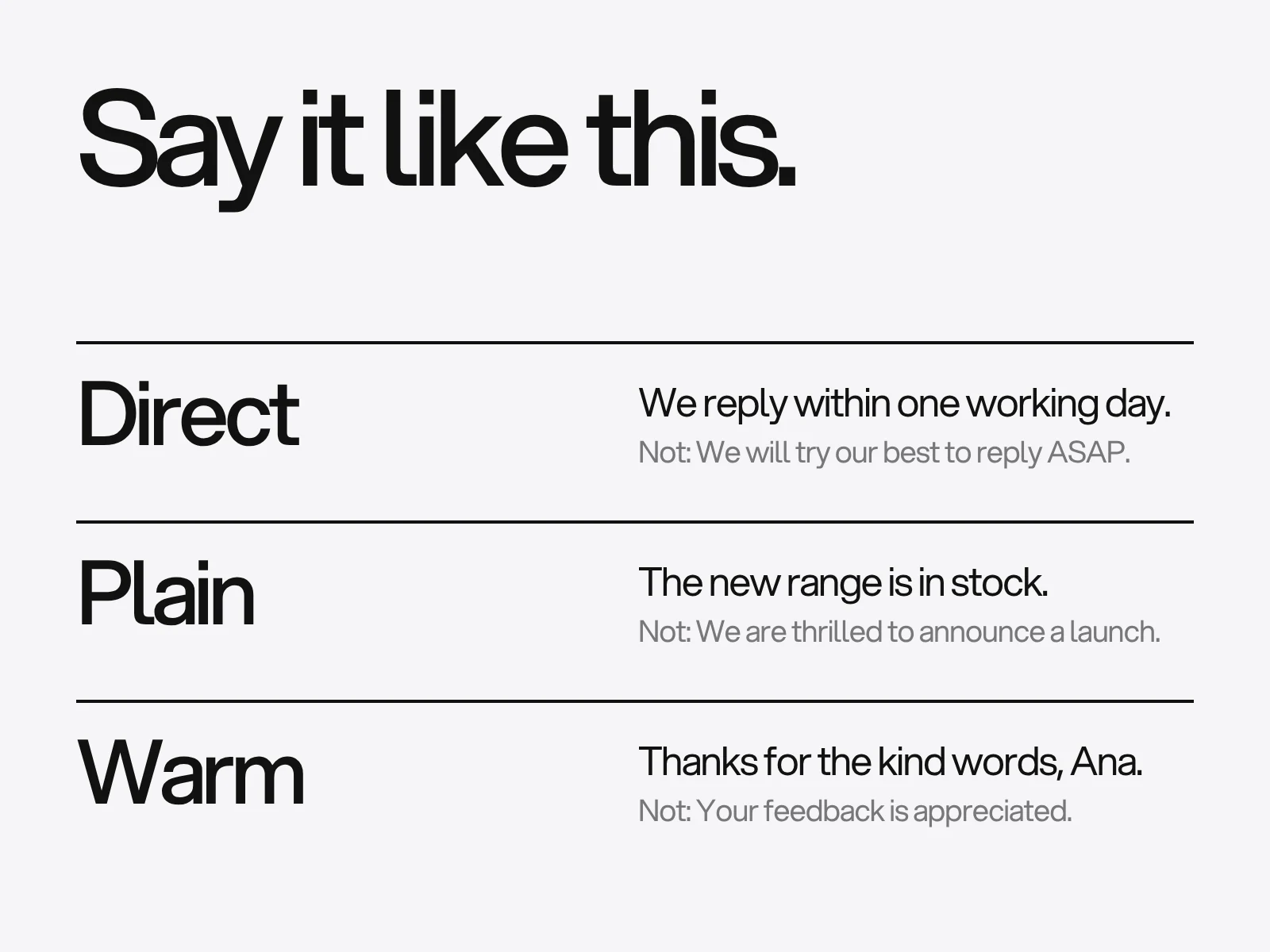
Voice needs the same treatment. Mailchimp's content style guide gives the principle: you have the same voice all the time, but your tone changes with the reader's emotional state. It does not give a map, so build one:
| Situation | Tone | Opens with | Never |
|---|---|---|---|
| A customer is angry | Calm, specific | Their name and the fact | Jokes, "we apologise for any inconvenience" |
| A customer is celebrating | Warm, brief | Thanks | Turning it into a sales pitch |
| A launch | Plain, confident | What it is and who it is for | Superlatives |
| Bad news or an outage | Direct, early | What happened and when it is fixed | Silence or euphemism |
| A tragedy in the news | Quiet | Nothing: pause scheduled posts | Anything pre-scheduled |
Hashtags, emoji and alt text: the parts with a spec
Hashtags. Capitalise each word. Screen readers need the capitals to separate the words, and so do people. In 2012 the lowercase #susanalbumparty for Susan Boyle's album was read by many as "anal bum party", and the team replaced it with #SusanBoyleAlbumParty. Some commentators suspected a stunt, and no confirmation was found either way. Accessibility guidance also asks for few tags at the end of the caption, because a post with 15 makes a screen reader user sit through all 15.
Emoji. Screen readers announce each emoji by its description, so "clapping hands" is read aloud, and text emoticons are read literally as "colon parenthesis". No official numeric limit exists, and the university guides differ. Set your own cap, put emoji at the end of text and put a space between them and words.
Alt text. Third-party guides describe Instagram's path as Advanced settings, then Write alt text, with a separate box for each slide of a carousel, though the menu labels vary with the app version. Stories cannot take alt text, so the on-screen text and the caption have to carry the meaning there. Instagram can generate alt text automatically, but it is a guess, so write your own. LinkedIn has an alt text control on desktop, and the guides disagree about mobile. Make the rule "every feed image has written alt text", and give Stories a separate rule.
Disclosure is a legal rule, not a style choice
Two regulators, one in the US and one in the UK, give different answers to the same question. The guide should not leave the choice to whoever is posting.
| Question | FTC, United States | ASA and CAP, United Kingdom |
|---|---|---|
| Is a hashtag needed? | Fine but not necessary. A plain line such as thanks to the brand for the free product is often enough if it is hard to miss | Prefers an explicit label such as "Ad", with or without a hashtag |
| The word "sponsored" | Listed as acceptable | Advises against it as open to varied interpretation |
| "sp", "collab", "ambassador" alone | Vague, not enough | "aff", "sp", "spon" likely insufficient |
| Placement | Hard to miss, not mixed into a group of hashtags, not behind a "more" click | At the beginning, visible without clicking "See more" |
| The platform's own label | Do not assume it is enough, use it as well | May be enough if upfront and prominent. The ASA's 2026 research suggests it may not be enough alone |
| Employees and owners | An employment relationship is a material connection | Content featuring the brand by employees, owners or directors must be obviously identifiable as advertising |
The two disagree about "sponsored", so use the intersection. Make the first word of any paid or gifted caption "Ad", and add a line for staff: if you post about our products, say you work for us. The FTC's Endorsement Guides were revised in 2023, and the FTC and the ASA only bind the markets they cover. Check the rules for each country you post to. This is a checklist, not legal advice.
Music, reposts and the pause button
Music. Meta says the music in Instagram's library is intended for personal, non-commercial use, that certain business accounts and posts do not have access to it, and it points those accounts to a royalty-free Sound Collection. Music-licensing vendors, who have an interest in the answer, add that a mainstream track on a business account can mean muted audio or a blocked post. Write "business accounts use only the licensed set, and nobody adds trending audio without asking" into the guide.
Reposts. The sources I found are marketing blogs, not Meta's terms, and they agree on one point: get permission first, and credit the creator. A written yes saved in a folder turns that into something you can check.
The pause. The practitioner advice is the same everywhere: a scheduled post can turn insensitive overnight. MarTech reported that most social management tools lacked a simple emergency stop, and some made you delete or reschedule posts one by one. So name the person with authority to pause every scheduled post and email, write down where the pause is in each tool, and test it once.
Approval by risk, not habit
A rule that says "everything is approved by the founder" gets bypassed. Score the post instead. Ask five yes or no questions:
- Does it mention a price, a claim, a number or a date?
- Does it feature a person outside the team?
- Does it react to news, criticism or a complaint?
- Does it use someone else's work or music?
- Is it paid, gifted or sponsored?
| Yes answers | Route |
|---|---|
| 0, from an approved template | Publish |
| 1 or 2 | One peer check |
| 3 or more, or question 5 | A named approver |
Question 5 always goes to a person because the disclosure line has to be right. This rubric is our suggestion, not a standard. Tune the thresholds against your own near misses.
Where this goes wrong
- A copied number. The guide repeats a 2022 template's hashtag count. Detect it by putting a "checked on" date next to every platform rule, and fix it with a quarterly calendar entry owned by one named person.
- Rules built from adjectives. They cannot fail, so everyone interprets them differently. Run the three-person test and rewrite any rule that produces three answers.
- No owner for platform rules. The platform changes, nobody is told, and the guide is wrong for a year.
- Approval so heavy it is bypassed. The signature is posts published from phones. Use the risk tiers so that routine posts skip review.
- Legal rules buried on page nine. Put the never-do lines on page one.
- A guide that contradicts the tools. The scheduler has no field for alt text or a tracking parameter, so the rule is never followed. Check each rule against the tool the team really uses.
What goes on page one
- The owner and the date of the last check.
- The never-do list: disclosure, written permission for reposts, licensed music only, who can pause.
- Platform rules, each with a date and a link.
- The tone map.
- Five posts that are exactly right.
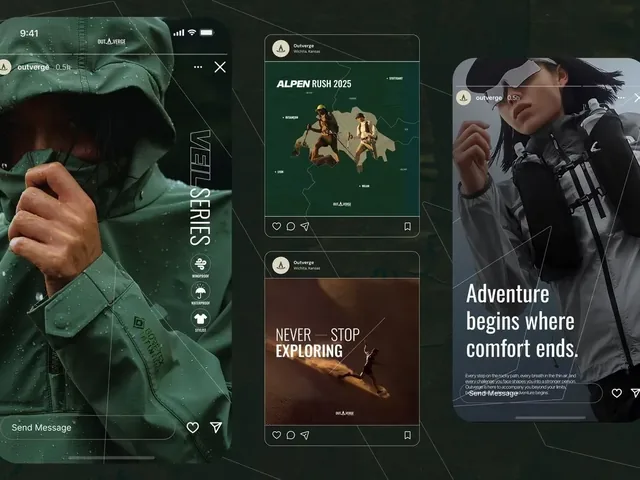
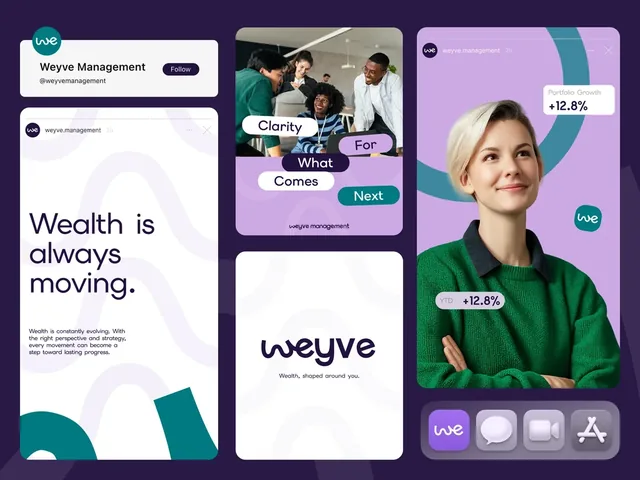
A guide of this kind sits next to your templates, your content calendar and your voice and tone guide. Our Outverge project shows the shape: its logo guideline gives each of three lockups its own grid, safe zone and short list of things it must never do, and the same structure works for social. See Outverge and Weyve for how a brand carries a system across posts. If your feed changes character with every new poster, start a project.
Frequently asked questions
How many hashtags should a brand use on Instagram now?
Five or fewer. Instagram said in December 2025 that it would gradually limit hashtags in the caption of a post or Reel to five, and that fewer, targeted tags work better than many generic ones. Reports disagree on whether comments are counted, and the rollout was gradual, so check what your account allows.
Is #ad required in a social media caption?
Not as a hashtag in the US, where the FTC says a hashtag is fine but not necessary if the disclosure is hard to miss and not buried in a group of hashtags. The UK ASA prefers an explicit label such as "Ad" at the beginning, visible without clicking "See more". Starting a paid caption with the word Ad satisfies both.
Do employees have to disclose that they work for the brand they post about?
Generally yes. The FTC says a material connection includes an employment relationship, and the ASA says content about a brand by its employees, owners or directors must be obviously identifiable as advertising. Put a line for staff in the style guide. This is not legal advice, so check the rules of each country you post in.
How do you stop a social media style guide from going out of date?
Sort the rules into taste, platform and legal. Put a "checked on" date and a link next to every platform rule, review them every quarter, and give one named person the job. Taste rules change at a rebrand, and legal rules change when the regulator's guidance does.
How can you test whether a social media style guide works?
Give three people who have not read it the same five jobs, such as a caption from a brief, a complaint reply, a hashtag set, alt text and an ad label, and compare the results. Where their answers differ, the rule is too vague. It is a cheap diagnostic rather than a validated method.
What is the difference between voice and tone in practice?
Voice stays the same and tone changes with the situation. Mailchimp's content style guide puts it as the same voice all the time with a tone that shifts with the reader's emotional state, so write a short map of situations, with the opening and the thing to avoid in each, instead of more adjectives.
Sources and fact check
Facts in this article that come from outside LAIN were checked on 28 Oct 2026 against:
- Social Media Today: Instagram implements new limits on hashtag use
- FTC: Disclosures 101 for Social Media Influencers
- FTC: Guides Concerning the Use of Endorsements and Testimonials in Advertising (16 CFR Part 255)
- Advertising Standards Authority: Recognising ads on social media
- Mailchimp Content Style Guide: Voice and tone
- W3C: Web Content Accessibility Guidelines (WCAG) 2.2
- Buffer: Social media style guide
- Accessible Social: Hashtags
- Texas Tech University: Social media accessibility
- Adweek: Worst (or best) hashtag ever, #susanalbumparty
- Instagram Help Center: music availability on Instagram
- MarTech: Most social media management tools still lack an emergency stop button
Timelines, services and process described here are LAIN's own, as set out on our About and FAQ pages.
[ Keep reading ]