[ Social media ]
Instagram content pillars: how to choose them and plan posts around them
Content pillars are the three to five themes your Instagram account returns to again and again. Choose them where your audience questions, your expertise and your business goals overlap, assign each a few formats, then plan posts from the pillars instead of from a blank page. Review the results every month and keep the pillars that people save and send.
By LAIN6 min read
Content pillars are the three to five themes your account returns to again and again. They answer the question of what to post. Choose them where your audience's questions, your expertise and your business goals overlap, give each one a few formats, and plan from the pillars instead of from a blank page.
What a pillar is, and what it is not
A pillar is a broad topic you have agreed to talk about repeatedly, not a single post idea. Brandwatch describes content pillars as the three to five core themes at the foundation of a social strategy, and notes that a calendar tells you when to post while pillars tell you what to post and why.
Three levels are easy to mix up:
- Pillar: the theme. "Process", meaning how we make things.
- Format: the shape of a post. A carousel, a reel, a story or a single photo.
- Series: a repeating idea inside a pillar. "Sketch to screen" every second Thursday.
One pillar produces many posts, in several formats, over months. If you can only think of one post for a pillar, it is a topic, not a pillar.
Why pillars help
- A consistent impression. People who land on your profile see a clear pattern, not a scatter. This is the same job your bio and grid do, covered in Instagram profile design.
- Faster planning. Deciding what to post takes longer than making the post. With four pillars, you only choose which one is next.
- Better content. Repeating a theme forces you to get good at it and to find new angles.
- A link to what Instagram rewards. In January 2025, Instagram head Adam Mosseri said the top signals for ranking are watch time, likes and sends, and advised creators to watch average watch time, likes per reach and sends per reach. Content that is useful or relatable enough to send to a friend is easier to produce when you have a clear theme to go deep on.
Choose three to five
Look for the overlap of three inputs.
- What your audience asks. List the questions from sales calls, emails and direct messages. Each repeated question is a pillar candidate.
- What you know better than most. Where do you have real experience, not general opinions?
- What the business needs. If enquiries are the goal, at least one pillar should lead naturally to your service.
Start with three if one person does the posting, and add a fourth or fifth only when you have the capacity. A pillar you cannot feed every few weeks is a pillar you will drop. Revisit them now and then, because pillars are flexible and can change as the business and audience change.
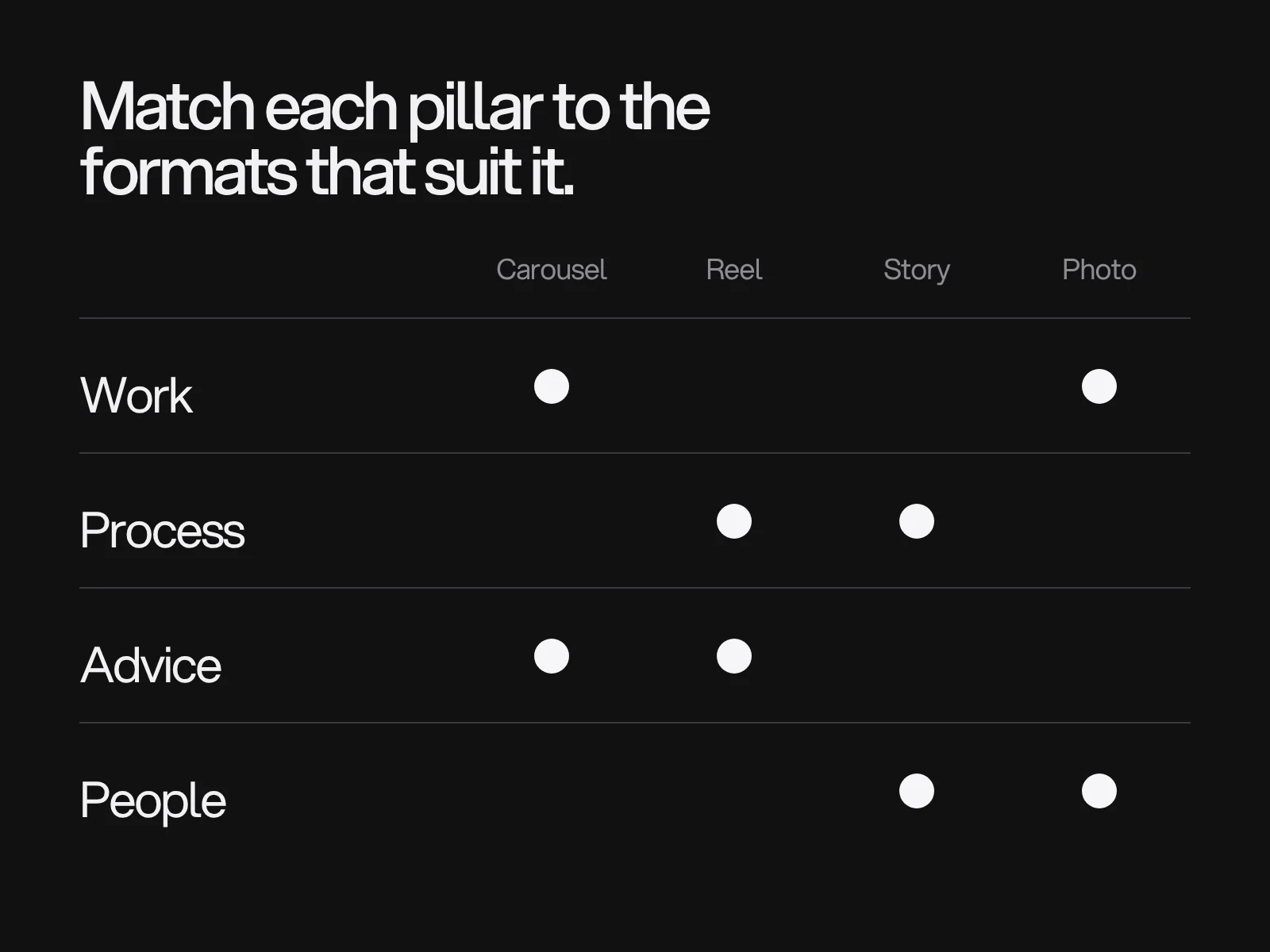
An example set for a service business
Here is a set for a design studio. Swap in your own field.
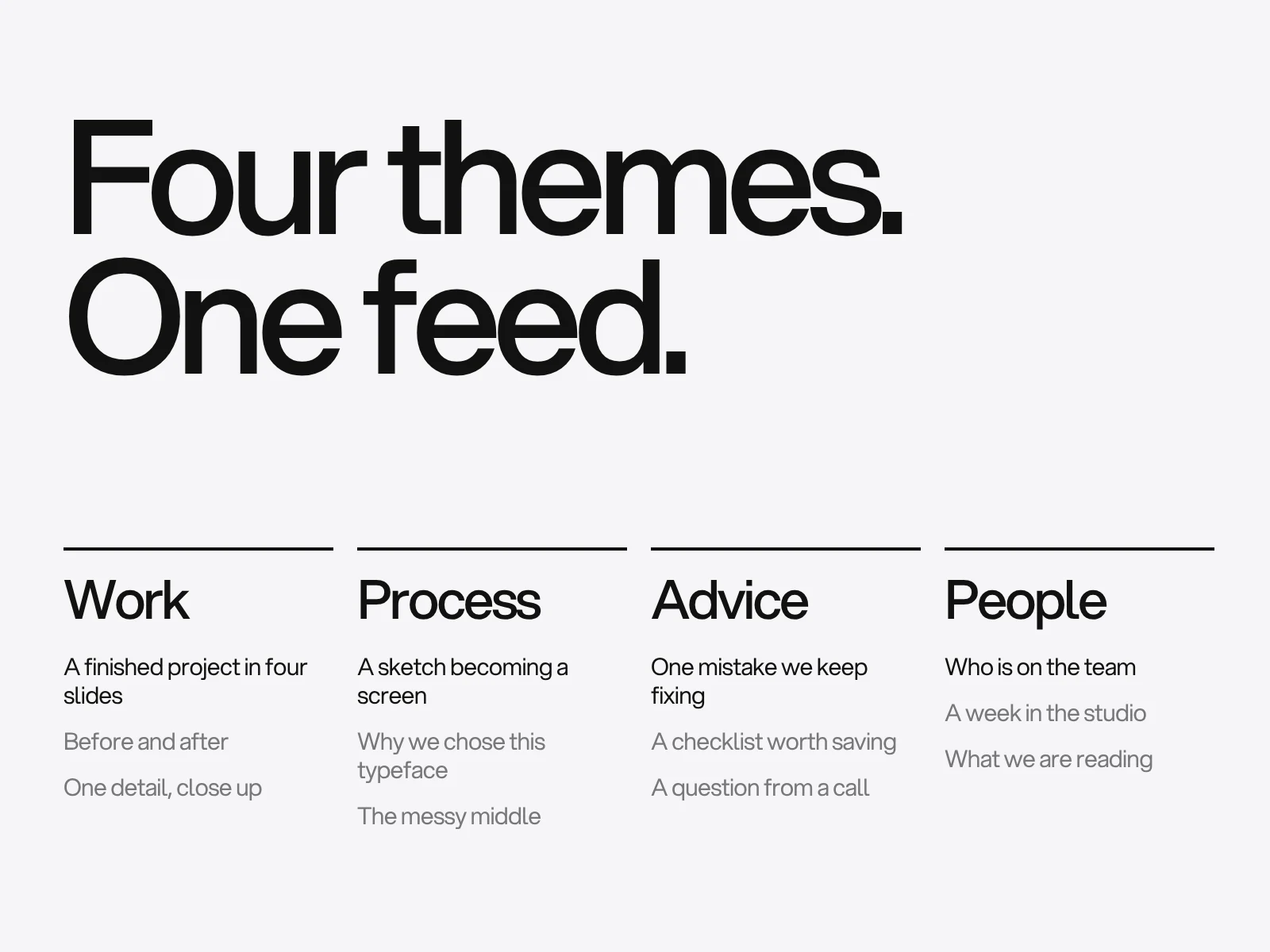
| Pillar | What it covers | Good formats |
|---|---|---|
| Work | Finished projects: the problem, the decision, the result shown | Carousel, photo |
| Process | How things get made: sketches, drafts, choices | Reel, story |
| Advice | One piece of expertise people can use today | Carousel, reel |
| People | Who is behind the work, and how the studio runs | Story, photo |
A product brand would use different names, for example Product, Use, Ingredients or Materials, and Community. The structure stays the same. One pillar shows what you sell, one shows how it is made or used, one teaches something, and one shows the people. For how a brand carries its look across such posts, see the Instagram work in our Monolith and RUS projects.
Match pillars to formats
Each pillar suits particular formats.
- Carousels work well for anything with steps or a story, such as a case summary or a checklist. See Instagram carousel design.
- Reels show motion and process, and give you reach beyond your followers.
- Stories suit light, frequent updates and behind the scenes.
- Single photos suit finished work and people.
Do not force every pillar into every format. Two formats per pillar is plenty.
Balance the mix
Weight the pillars by your goal, not equally. If enquiries are the priority, give the most room to Work and Advice, which show competence and help the right people find you. Keep a lighter pillar, such as People, for trust. Avoid a feed that is all promotion. A pillar that only sells is an advert, and people scroll past adverts.
Turn pillars into a repeatable plan
- List ten post ideas for each pillar. Use real questions, projects and mistakes, not abstract topics.
- Assign a format to each idea.
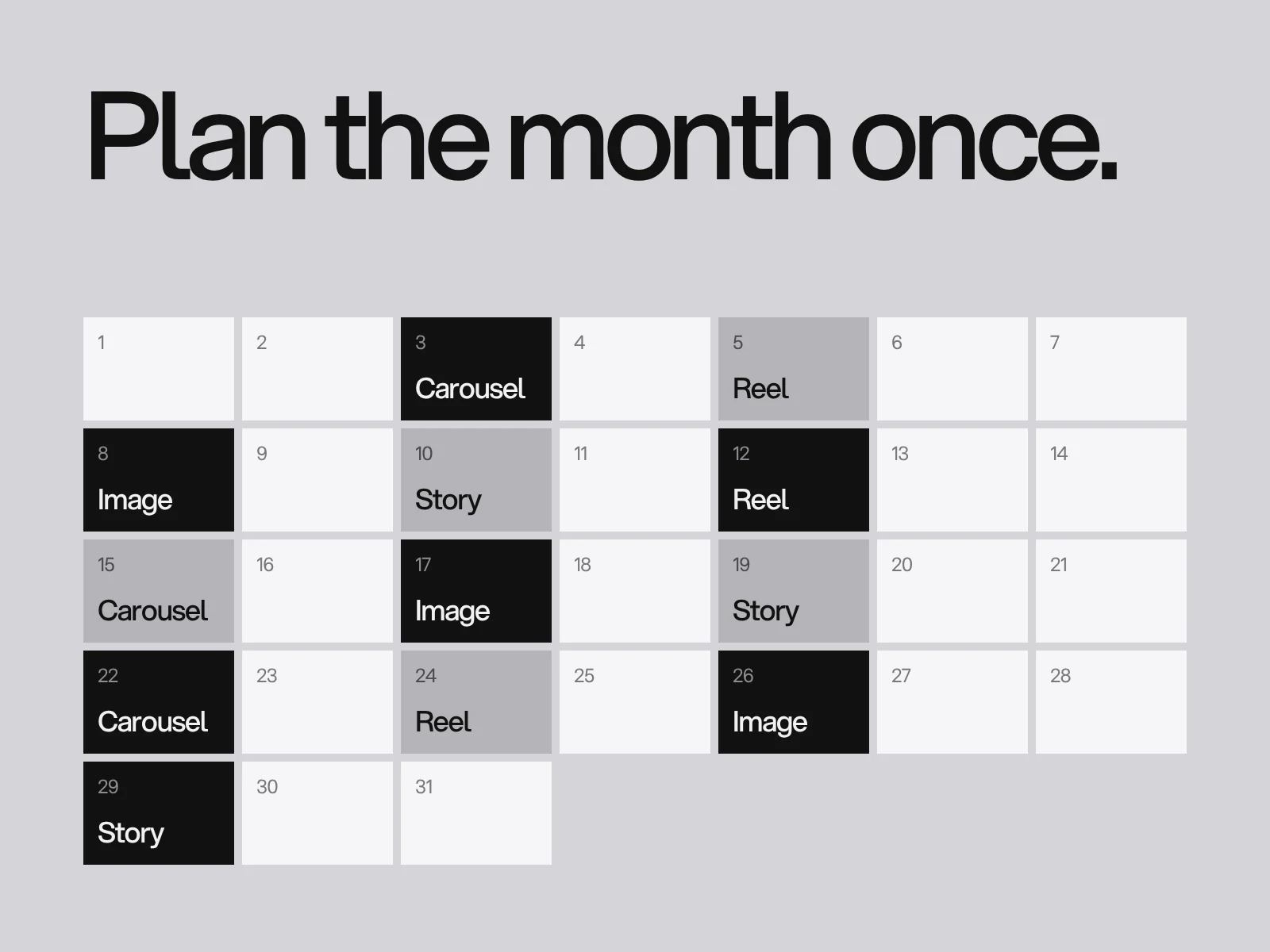
- Choose a rhythm you can keep for six months. It is better to post twice a week for half a year than daily for a month.
- Batch the work. Write and design several posts in one session, in the same template.
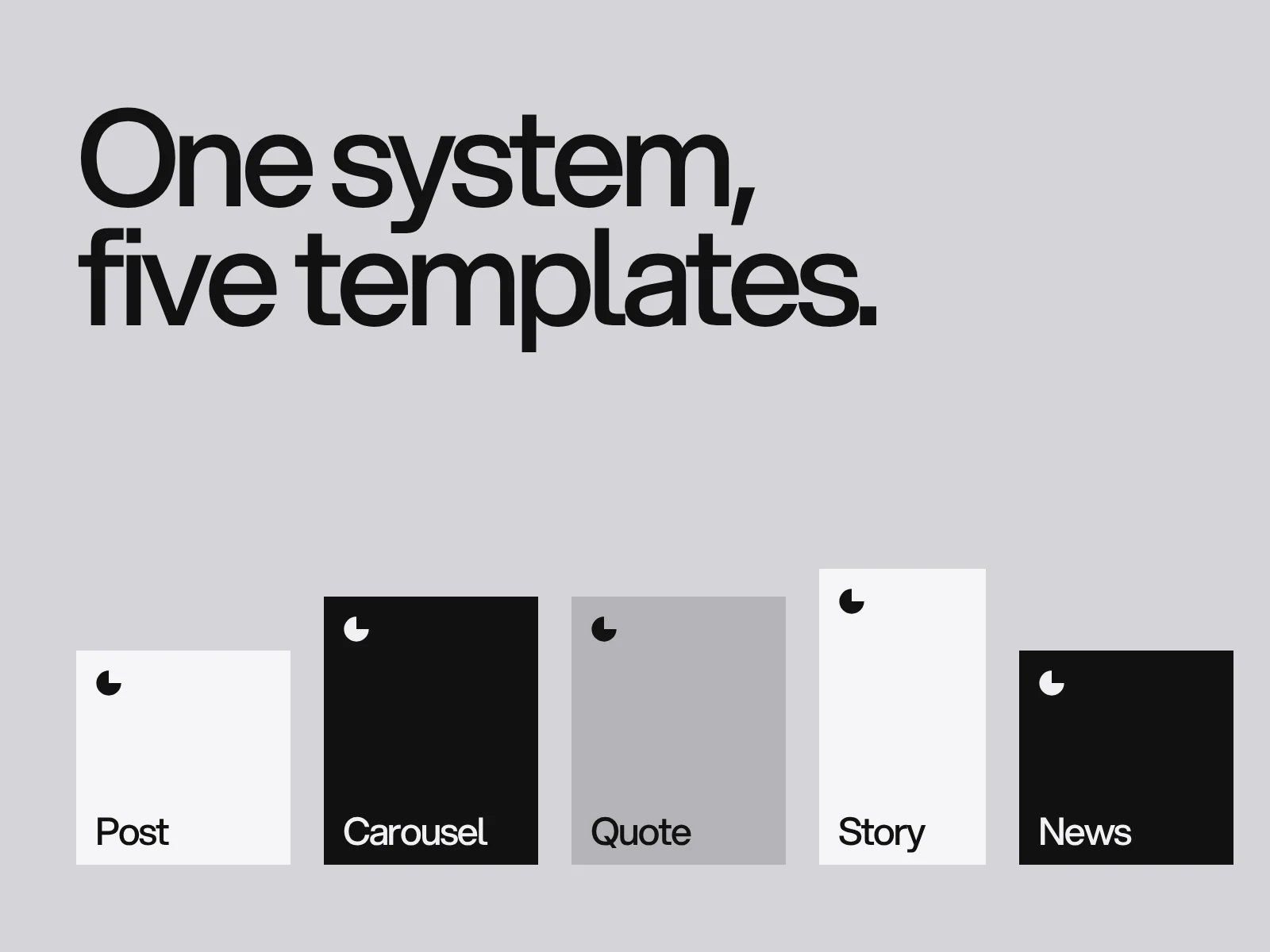
- Use templates. Set up reusable layouts for each pillar so posts look related without being identical. See social media templates for brand consistency.
Check what works
Review after every eight to twelve posts, or monthly. Open your Instagram Insights and compare pillars, not single posts.
- Reach and watch time show whether a theme interests people beyond your followers.
- Saves and shares show usefulness. Instagram's own ranking guidance says saves and shares are among the main signals it uses to judge interest in content on Explore.
- Profile visits, follows and messages show whether a pillar moves people toward you.
Then decide. Keep the pillars that earn saves, shares and messages. Change the angle of one that gets views but no action. Drop one that you dread making and that nobody reacts to, and replace it with something from your question list.
Common mistakes
- Too many pillars. Seven themes is a scatter with labels.
- Pillars that are really products. A list of services is not a content strategy.
- No link to a goal. Posts that are nice to look at but never lead anywhere.
- Never reviewing. A pillar chosen once is a guess. Check it against the results.
Where we come in
We design the look that holds the pillars together: the profile, the templates and the carousels. Social media design at LAIN is an ongoing service, so we plan around your pillars and rhythm, not a one-off project. If you want a system your team can post from, see our social media design service or start a project.
Frequently asked questions
What are content pillars on Instagram?
Content pillars are the three to five core themes an account posts about repeatedly. Each pillar is a broad topic, such as process or advice, that produces many individual posts in different formats.
How many content pillars should I have?
Three to five is the usual range. Start with three if one person manages the account, and add more only when you can feed each one regularly.
How do I choose my content pillars?
Find the overlap between the questions your audience asks, what you know well and what your business needs. List real questions from sales calls and messages, and turn the repeated ones into pillars.
What is the difference between a content pillar and a content format?
A pillar is the topic and a format is the shape of the post. Process is a pillar, and a reel or carousel is a format. One pillar can use several formats.
How often should I post on Instagram?
Post at the rhythm you can keep for at least six months. Consistency matters more than frequency. Twice a week sustained over time beats daily posting that stops after a month.
How do I know if a content pillar is working?
Review your Instagram Insights after eight to twelve posts. Look at reach, watch time, saves, shares, profile visits and messages for each pillar. Keep the ones that lead to saves, shares and enquiries, and replace the rest.
Sources and fact check
Facts in this article that come from outside LAIN were checked on 28 Oct 2026 against:
- Brandwatch: Content pillars
- Social Media Today: Instagram shares algorithm insights for 2025
- Instagram: Instagram Ranking Explained
- Instagram for Creators: Understand Instagram Insights
Timelines, services and process described here are LAIN's own, as set out on our About and FAQ pages.


[ Keep reading ]