[ Branding ]
Brand strategy for a small business: one page, built on buying situations
The standard advice is to pick one customer and write a positioning statement. Research on how brands grow adds a correction: being easy to think of in many buying situations matters more than excluding buyers. Start with one beachhead customer, then choose three to five buying situations through a filter, and put both on one page.
By LAIN10 min read
Most brand strategy advice for small businesses says the same two things: choose a niche, then write a positioning statement. That is half right, and the half it leaves out decides whether the page changes anything you do. Researchers who study how brands actually grow say that narrowing who may buy does not grow a brand. Being easy to think of, in many buying situations, does. Both camps are right once you separate who you start with from the situations you want to own. This guide builds a one-page strategy that way. The example is nova, an invented booking service for independent clinics.
Where the advice conflicts
The positioning school (Al Ries and Jack Trout, *Positioning*, 1981; Geoffrey Moore, *Crossing the Chasm*, 1991; April Dunford) tells you to be specific. Dunford's one-line version: positioning defines how a product is different and better than the alternatives for a particular set of customers. A book summary lists her components in this order: competitive alternatives, unique attributes, value, best-fit customers, market category. The customer comes after the alternatives, not before.
Moore's original template is more precise than the short version in circulation. As quoted from page 186, it reads: for (target customer, beachhead segment only), who are dissatisfied with (the current market alternative), our product is a (category) that provides (a compelling reason to buy), unlike (the alternative), we have assembled (the features that suit this application). Two things get dropped in most copies. The customer is a beachhead, the place you start, not the only people allowed to buy. And the dissatisfaction with the current alternative is named. That line is where most of the strategy lives.
The Ehrenberg-Bass school (Byron Sharp, Jenni Romaniuk) says growth comes from reaching as many category buyers as possible, most of whom buy only occasionally, by being easy to think of in buying situations (mental availability) and easy to buy (physical availability). Their "double jeopardy" finding is that smaller brands have fewer buyers and those buyers are a little less loyal. The Institute puts it bluntly: it is tempting to think small and go for low reach, but that is not a recipe for growth, or even maintenance.
Which to trust? They answer different questions. Nobody has heard of a new brand, and nobody can be reached all at once, so a start needs a beachhead. Once a brand has a foothold, the evidence says to widen. A review from the University of Turku notes that niche businesses face structural limits on mass reach, and we found no study that tests niche against mass strategies head to head. Our reading, and it is a judgement: narrow each message to one situation, widen the number of situations over time, and never write "not for" into the brand unless it is true by design. Romaniuk says the same about advertising: focus on one entry point per execution, but build links to different ones over time.
Describe situations, not segments
Romaniuk calls the situations category entry points (CEPs): the cues, internal such as a motive or emotion and external such as a place or time, that buyers use to retrieve brands from memory when they face a buying situation. They answer the sentence "I am looking for a brand that..." The evidence for caring is specific. In a US business insurance study of 606 decision-makers, State Farm, with 25% penetration, had more people holding six or more entry points and fewer holding none than Hartford (15%) or Hanover (5%). Across 17 insurance products, the fewer entry points a customer linked to their supplier, the likelier they were to say they might switch, significant in 16 of 17. Each extra entry point cut the stated probability of defecting by about 5%.
Her prompts are the W's: why, when, where, while (what else is happening), with what, with whom, and how the buyer feels. For nova, one answer to each: why (to stop losing patients), when (after hours), where (a second site), while (the receptionist is with a patient), with what (the clinic's records system), with whom (the practice owner signs off) and how (dread of the Monday voicemail pile).
Filter them with three Cs
Romaniuk's selection is a process of elimination with three tests: credibility (can you deliver it, and would buyers believe you), competitiveness (how many brands already own the situation) and commonality (how often it comes up, or how large the deals are). Her shortlist for a B2B brand with survey data is 5 to 8; a small business can start with three. Here is nova's list, invented:
| Situation | Credible? | Already claimed? | How often? | Verdict |
|---|---|---|---|---|
| The phone rings out while the receptionist is with a patient | Yes | By nobody in particular | Daily | Keep |
| The receptionist is off sick | Yes | By nobody in particular | Monthly | Keep |
| The Monday voicemail pile | Yes | By nobody in particular | Weekly | Keep |
| A patient wants to book at 9 pm | Yes | Online booking widgets | Daily | Later |
| Cutting no-shows with reminders | No, nova does not send them | Many tools | Daily | Cut |
| Replacing the records system | No | Many vendors | Rare | Cut |
| A second site opens | Partly | By nobody in particular | Rare | Cut |
| Answering in several languages | Partly | By nobody in particular | Rare | Cut |
Check the beachhead is big enough with arithmetic, not hope. Reachable customers needed is the target divided by your win rate among those you can reach. For 60 paying clinics at an assumed 6% win rate, you need about 1,000 reachable clinics. At 3% you need 2,000. The win rate is an assumption to test, but the sum tells you whether the niche is a business.
Find the situations by interview
Ask about the last time, not the future, and do not pitch. Six questions: tell me about the last time a patient could not get through; what happened next; what did it cost you in time or patients; what have you tried, and why did you stop; who else was involved; when did it last happen. These come from our own synthesis, not a published script. Eight to twelve interviews with one type of customer is a sensible start. The standard source on saturation, Guest, Bunce and Johnson (2006), drew on 60 interviews, and secondary summaries report that 92% of the codes in one 30-interview set appeared within the first 12. That is a homogeneous group, so mixing customer types needs more.
The page
Put the strategy on one page with seven parts.
| Part | The question | nova, invented |
|---|---|---|
| Beachhead | Who do we start with? | Independent clinics with a small front desk |
| Alternative | What do they use now, and what do they dislike? | A shared inbox nobody watches after 5 pm |
| Difference | The one thing the alternative cannot do | Books the appointment while the patient is still on the line |
| Proof | What can we show today? | Live call logs, named clinics, customer words |
| Situations | Which three to own, with one line each? | Rings out, off sick, Monday pile |
| Personality | Three words, each with a "but not" | Calm, not sleepy. Precise, not cold. Warm, not cute |
| We will not | What do we decline? | Reminders, records, anything clinical |
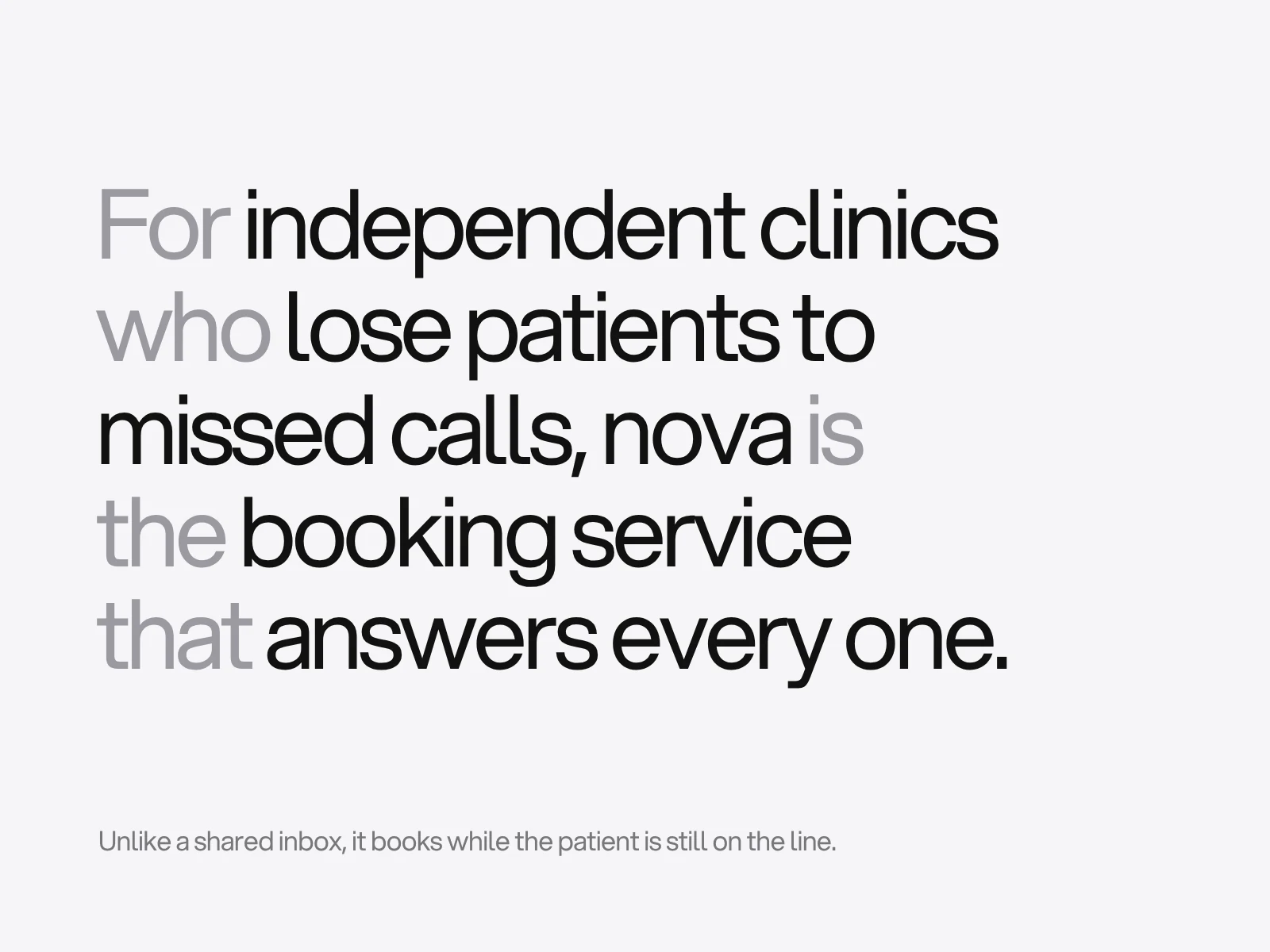
The statement that falls out of it: for independent clinics dissatisfied with a shared inbox nobody watches after 5 pm, nova is a booking service that answers every call, unlike an answering service that only takes messages, because it books while the patient is still on the line.
The last row follows Richard Rumelt's argument in *Good Strategy Bad Strategy* (2011). Summaries give his kernel as a diagnosis of the challenge, a guiding policy that answers it, and coherent actions, and his warning signs as fluff, ignoring the challenge, and treating goals as strategy. Our mapping, not his: the alternative's failure is the diagnosis, the difference is the policy, the situations are the first actions, and "we will not" shows you chose.
Use it to decide
- The swap test. Put a competitor's name in the statement. If it is still true, it is not a position.
- The refusal test. Name one request you would now turn down. If you cannot, the page has changed nothing.
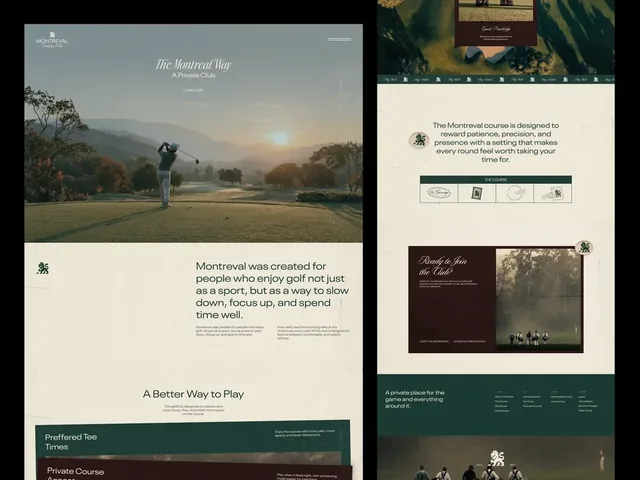
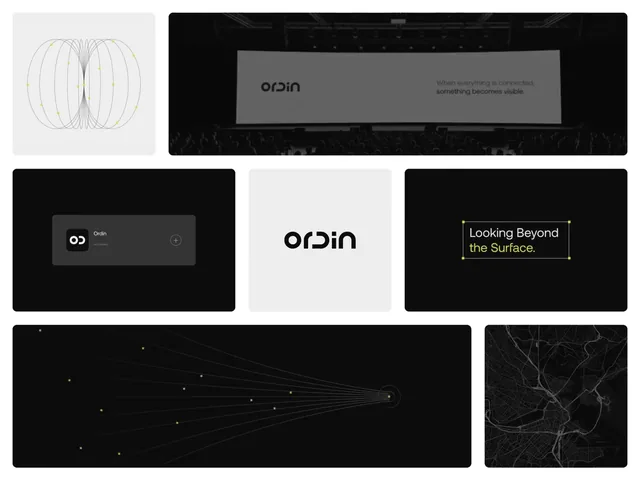
- The design test. Two of our projects show strategy turning into a constraint. Montreval is a private Geneva club where membership is kept intentionally small, and its page says the work had one rule: calm, private and unmistakably established, without looking dated. Ordin had to be calm and exact enough for a ministry and modern enough for an AI company, with one citrine colour kept for data. A strategy page gives every later choice, from name to logo to homepage headline, something to be checked against.
To see whether it works, repeat the question "when the phone rings out, which providers come to mind?" with category buyers, and count how many name you. Romaniuk's mental penetration is buyers who link the brand to at least one situation, divided by the sample (472 of 609 is 78% in her business banking example), and mental market share is the brand's share of all links (3,732 of 37,948 is 9.8%). Sample size matters. With 30 people a measured share has a margin of about 18 points at 95% confidence, with 50 about 14, and with 12 about 28, so only large changes show.
Where it goes wrong
| What happens | Cause | How to spot it | Fix |
|---|---|---|---|
| The customer is a demographic, and no message follows | A segment says who, not when | You cannot write the first line of an ad | Describe the situation they are in |
| The position sounds like everyone's | Category words ("trusted", "quality") are claimed by all | The swap test passes for a competitor | Use the alternative's failure, in the customer's words |
| The niche is too small | Nobody did the sum | Reachable customers fall short of the target divided by the win rate | Widen the beachhead or the price, not the claim |
| The proof is adjectives | Nothing was collected | You cannot link to it | List only what you can show today |
| The page is never used | It has no "we will not" | Nothing was declined this quarter | Add the row and review it each quarter |
| Tracking shows noise | Samples of 12 to 30 | Results swing from wave to wave | Track every six months with 50 or more, or use interviews |
In a brand project
Strategy work sits in the first of our four phases, Alignment: a moodboard and a questionnaire to learn your goals, brand and audience. A brand identity project takes 4 to 6 weeks, and guidelines arrive in final delivery. Bring your interview notes and the page from this guide; start a project when you are ready to turn it into an identity. See our guides on brand voice and when to rebrand.
Frequently asked questions
What is brand strategy in simple terms?
A short set of decisions about who you start with, what the alternative gets wrong, what you do differently, what proves it, which buying situations you want to be the obvious answer in, and what you will not do. It comes before the logo and website, and everything after is checked against it.
Should a small business target a niche or everyone?
Both camps have a point. Positioning advice says start with a specific beachhead customer; Moore's original template says exactly that. Growth research from the Ehrenberg-Bass Institute says growth needs reach beyond loyal customers. Start narrow in your message, one situation at a time, and widen the situations you cover without excluding buyers.
What are category entry points?
Category entry points are the cues buyers use to retrieve brands from memory when a buying situation arises, such as a time, place, motive or feeling. Jenni Romaniuk's research links more entry points per brand to lower switching: about 5% lower stated probability of defecting for each extra one in her business insurance study.
How many customers should I interview?
Eight to twelve for one customer type is a sensible start. A widely cited 2006 study of 60 interviews reported that most themes appeared early, with secondary summaries giving 92% of codes within the first 12 in one set. That was a homogeneous group, so mixed audiences need more.
What goes in a positioning statement?
Moore's original names a beachhead customer, the current alternative they are dissatisfied with, your category, the compelling reason to buy, the alternative you differ from and the features that fit. The common short version drops the dissatisfaction line. Write it for internal decisions, not as a tagline.
How do I know if my brand strategy is working?
Ask category buyers which providers come to mind in each situation you chose, and count how many name you. Small samples are noisy: with 30 people the margin is about 18 points at 95% confidence, with 50 about 14. Track every six months, or rely on interviews and on what you have declined.
Sources and fact check
Facts in this article that come from outside LAIN were checked on 28 Oct 2026 against:
- Jenni Romaniuk, B2B Institute: Category Entry Points in a B2B World
- Ehrenberg-Bass Institute: Answering critics
- Product Bites: Clarity and discovery through value positioning statements (Moore, p. 186)
- April Dunford: Positioning
- Reading Graphics: Book summary, Obviously Awesome
- Wikipedia: Al Ries (Positioning, 1981)
- Guest, Bunce and Johnson: How many interviews are enough? (Field Methods, 2006)
- University of Turku: review of Ehrenberg-Bass theory and niche markets
- Concepts: The kernel of good strategy (Rumelt, summary)
Timelines, services and process described here are LAIN's own, as set out on our About and FAQ pages.
[ Keep reading ]